
Search
Kapsur
KAPSUR durum
Champs à renseigner
Texte
New generations of durum wheat are characterized by significantly higher yield potential, which makes production even more profitable. Thanks to the competitive market and higher added value, profitability per unit area is significantly higher compared to conventional production. Durum wheat is recognizable by the high content of yellow pigments in the semolina, which is why it is not necessary to add egg yolk during the production of pasta, because it naturally acquires a characteristic golden yellow color. Kapsur is the first variety of durum wheat that we introduced into production on larger areas. Based on past experiences, we can say with certainty that under optimal production conditions, it achieves yields comparable to winter bread wheat. The yield potential is from 6.5 to 9 t/ha. Plant height ranges from low to medium, depending on weather conditions. The use of growth regulators is recommended in intensive cultivation systems. The harvest timing does not differ significantly from that of common wheat; however, to maintain grain quality, we recommend harvesting promptly once the crop has matured, without delay.
Champs à renseigner
Image standard

Champs à renseigner
Texte
✔ Mid-early winter durum wheat
✔ High adaptability to various conditions
✔ Excellent winter hardiness
✔ Large grain, high thousand-kernel weight
Agro-technical characteristics:
Optimal sowing time: October 5–20
Seeding rate: 450–500 viable seeds/m²
Quality characteristics:
High protein content: >14%
High wet gluten content: >30%
High hectolitre weight
Good vitreousness
High yellow pigment content
Tolerance to plant diseases:
Fusarium: moderate tolerance (5/10)
Powdery mildew: good tolerance (7/10)
Yellow rust: good tolerance (7/10)
Septoria: excellent tolerance (9/10)
Citation
Quality in every ear! Yield on every sown hectare!
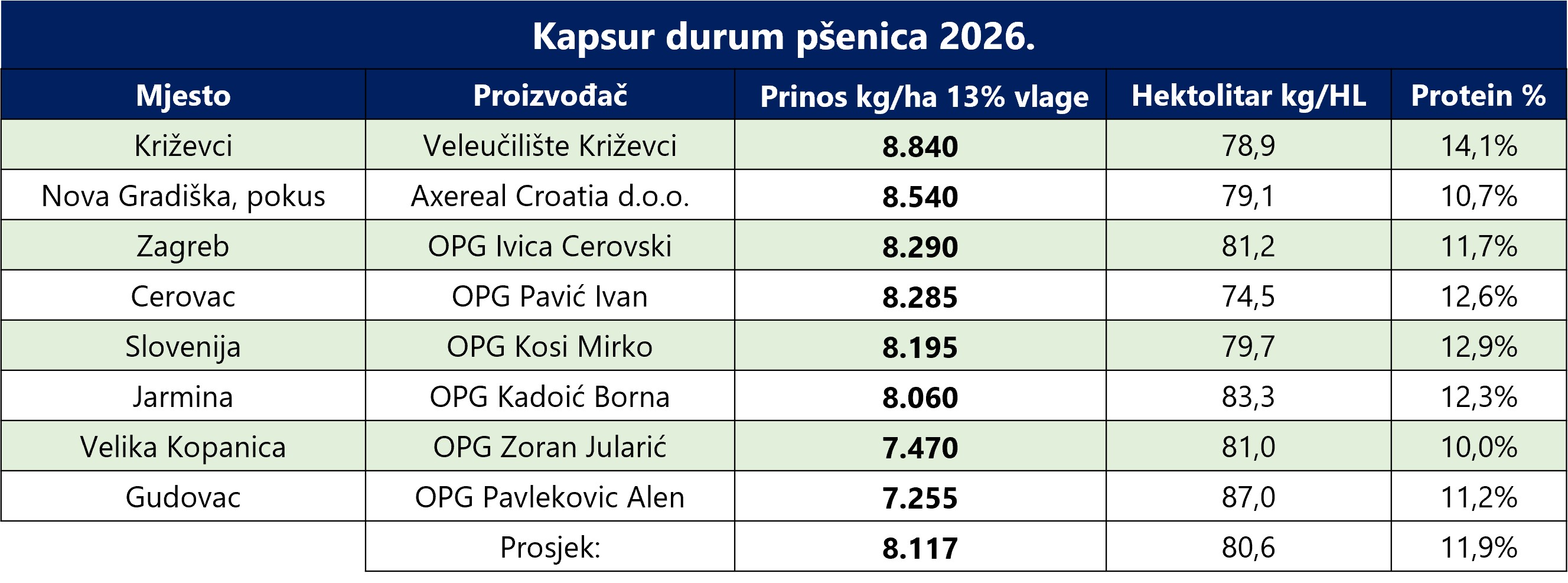
Kapsur yield 2026:
Champs à renseigner
Texte
Champs à renseigner
Vidéo
Texte
💡Good to know: The best preceding crops for durum wheat are soybeans, peas, alfalfa, rapeseed, and potatoes. Moderately preferred previous crops are sunflower and sugar beet. Corn should be avoided as a previous crop, as well as cultivation in monoculture or in a narrow crop rotation with wheat. The nutrient requirements are the same as for winter wheat. In order to preserve grain quality, it is recommended to harvest before possible precipitation
Image lien

Image lien 2

Image lien 3

Champs à renseigner


