
Search

Image
Body
Groupe paragraphe
Champs à renseigner
Texte
Article is published on www.poslovni/hr , Autor: Siniša Malus
Axereal Croatia, a company that today operates in seven locations, connects Croatian producers with the European market, invests in seed production and develops peas as a new business direction, marks a quarter of a century of successful business. From a company focused on cereals and malting barley, it has developed into one of the key leaders of the domestic agrarian sector and a complete partner to Croatian farmers, following the changes and needs of Croatian agriculture.
Today, the company manages the entire value chain - from the production, testing and processing of high-quality certified seeds adapted to climate changes, through the provision of top-quality inputs and up to the contracting and buying-back produced goods. We talk about all this with Sarah Mingham, CEO of Axereal Central Europe.
Champs à renseigner
Texte
How was business last year, what are the trends this year, and what are the expectations for the next?
Looking globally, business in the agricultural sector was extremely challenging last year, marked by high volatility and strong pressure on producer profitability. Despite this, we managed to further improve operational profitability. We achieved EUR 92.8 million in revenue, and EBITDA amounted to EUR 2.68 million, which is the second consecutive year of positive results at that level. Compared to 2023, we also significantly reduced the net loss, by almost 90 percent.
These results are part of a wider story about the development of the company, which this year marks 25 years of successful business in Croatia. From the beginning, strongly linked to cereals and malting barley, over the years we have developed into one of the leading players in Croatian agriculture, with business that today includes seed production, seed processing, supply of raw materials, production contracting, buying-back goods and logistics. Today, we operate at seven locations in Croatia, cooperate with around 1,500 customers and cooperants, and connect Croatian producers with European markets.
Citation
We believe that the future does not lie in relying on just a few crops, but in the careful selection of varieties and the development of production that can better respond to different conditions.
Texte
Such business results were also greatly influenced by the employees, whose efforts and expertise are an important factor in development and leading market positions. In Croatia, we have a hundred employees, whose average net salary has increased by 30 percent in 2025. Every year, we also pay a Christmas bonus of more than a thousand euros, as part of our employee reward practice.
When we talk about current trends, in addition to traditional cultures, production contracting and purchase, we pay more and more attention to seed production, adaptation to climate changes and the development of cultures that have not been represented so far in Croatia. One example is the protein pea, which opens up new opportunities for producers and corresponds to the ever-expanding development of the plant protein market. At the same time, we continue to develop the production of malting barley, wheat, corn, soybeans and other crops in our portfolio. In 2027, we want to continue to grow and further strengthen our role as a partner that connects producers and the market and actively participates in the development of future agricultural production.
Does seed production still remain a strategic part of Axereal Croatia's business?
Seed production is still one of the most strategically important parts of our business and an area in which we continue to invest. In the last five years, we have invested two million euros in seed processing, and today we process about ten thousand tons of seeds annually. We have 2,600 hectares of our own arable land and storage capacity of 66,000 tons, and our portfolio includes 13 crops and more than 30 varieties of wheat, premium malting barley, and recognizable varieties of soybeans and protein peas.
An important part of that development is the modern seed processing center in Nova Gradiška, the first such specialized center in Croatia. But even more than investing in equipment and capacities, it is important for us to select and develop varieties that suit the conditions in Croatia, which is why we test different varieties on our own land and monitor how they behave in local conditions. We pay special attention to quality, yields and adaptation to changing climatic conditions. Our ultimate goal is to be a reliable partner to farmers even before production begins, to help them choose appropriate seeds and make decisions that will ensure their profitability and safety in the field.
What are the current trends in seed production and where do you see room for future growth?
One of the most important trends is the development of varieties that can respond to increasingly changing production conditions, especially when we talk about climate change. Longer periods of drought, high temperatures and increasingly frequent weather events place new demands on farmers. That is why it is important to develop and select varieties that suit local conditions, but also to check how they behave in actual production. Farmers need quality seeds, but also reliable information about how each variety will behave in specific conditions.
The second direction is the expansion of the portfolio to include crops that have not been represented so far in domestic production. Peas is a good example because it allows us to develop a new area of business and at the same time follow wider changes in the vegetable protein market. This is an area in which we see potential both at the level of Croatian agriculture and within our group. Agriculture is in the genes of Croats and a lot of knowledge is passed down from generation to generation, but more and more people, especially the younger generations, are inclined to education, trying proven practices, and digitizing their work, which is why I believe they have the right partner and support in Axereal.
Image standard
Description Image
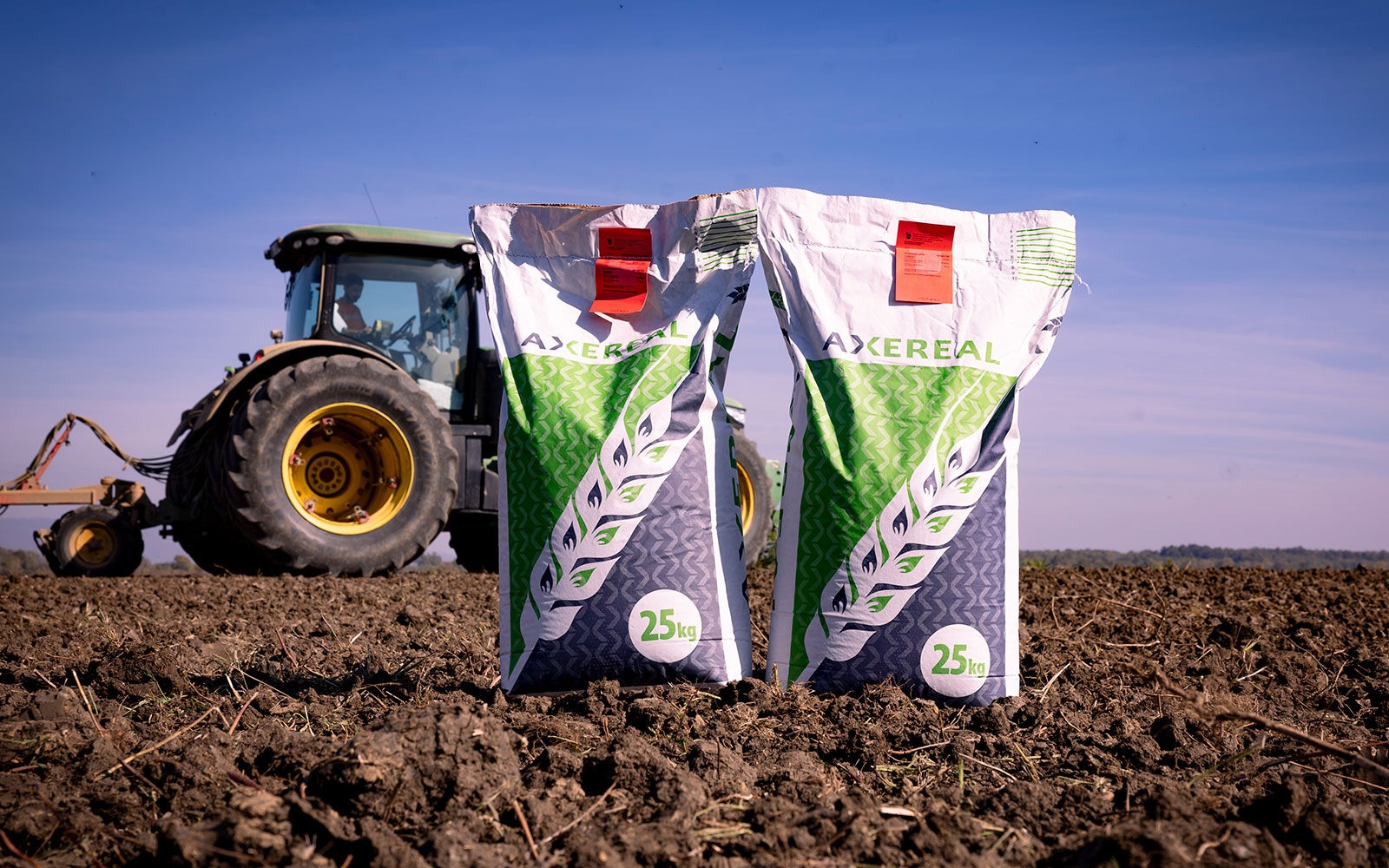
In the last five years, we have invested two million euros in the preparation of seeds, and today we process about ten thousand tons of seeds annually, Mingham points out.
Texte
You move from traditional crops to protein crops: peas open up a new direction of development, and malting barley remains the foundation of the business. Why are peas interesting?
As I already mentioned, peas open up the possibility of developing a new business segment, and at the same time correspond to the direction in which our group is developing. Plant proteins are an increasingly sought-after product globally, in the long term, and much more sustainable than the production of proteins of animal origin. This is only part of the reason why Axéréal decided to process legumes, especially protein peas, for the food and other industries.
In Croatia, we have already taken concrete steps in the development of that culture. We currently produce seed peas on approximately 300 hectares, which, according to our data, is the largest production of that crop in the country. We develop seed pea production, test varieties and adapt production to local conditions. Our goal is to gradually develop knowledge and experience that will enable more reliable production and to assess under which conditions and on which surfaces this culture can be successfully spread.
At the same time, we do not neglect what we built our business on. Brewing barley is still one of the foundations of our business and an important part of our identity. We cooperate with a network of domestic producers, and we sell the produced barley to Slavonija Malt, which means that domestic agricultural production is directly connected to the chain of malt production. We do not see peas as a replacement for traditional crops, but as an opportunity to expand production and open up additional opportunities for Croatian farmers.
Nova Gradiška is developing as an 'innovation hub' for new and less represented cultures. What can you tell us about it?
Axereal has a long tradition of investing in research and development, and we have transferred this practice to Croatia, where in Nova Gradiška we connect our own agricultural areas, production and processing of seeds, experimental areas, storage capacities and activities related to the production and purchase of agricultural crops in one place. In accordance with the highest environmental and sustainability standards at that location, we test new varieties and cultures in real production conditions, monitor the results and assess whether they have the potential for wider application in Croatia and beyond. This is especially important for cultures that are not yet widely represented, because before introducing them into larger production, we want to better understand their possibilities and requirements.
Peas are one of the examples we are already working on, through assortment development, adaptation of production to local conditions and testing of its potential. At the same time, cooperation with farmers is also important to us because their experiences help us to assess what is applicable in practice and what kind of support they have. In addition to being an interesting alternative in crop rotation, peas as a legume contribute to the binding of nitrogen in the soil, which can reduce the need for nitrogen fertilizers for the crops that follow. For farmers, this means potentially lower production costs and better production economics, with simultaneous environmental benefits.
In the long term, our goal is not only to produce new crops on our own land, but to create the preconditions for them, where there is potential, to spread to the lands of our subcontractors. This implies connecting knowledge, quality seeds, testing and experience gained in production, but also connecting with the market so that producers have a clearer perspective for the placement of their products. We believe that precisely such an approach can contribute to the development of a more diverse and adaptable agricultural production in Croatia.
Citation
Plant proteins are an increasingly sought-after product globally, in the long term, and much more sustainable than the production of proteins of animal origin.
Texte
You say that the long-term goal is not only to produce new crops on your own land, but to create prerequisites for their spread through knowledge, seeds, testing and cooperation with producers. In what direction could that expansion go?
There is probably no farmer who has not asked himself what and how he will produce in 10 or 15 years, given the climate changes we are witnessing every day. That is why we believe that the future does not lie in relying on just a few crops, but in the careful selection of varieties and the development of production that can better respond to different conditions.
New crops, such as Axereal is devotedly testing, should be more resistant to droughts and high temperatures, healthier and actually reduce the economic risks faced by farmers. By finding, testing and producing suitable varieties on our own land, our goal is to support the development of sustainable agriculture and quality seeds. At the level of the group, one of the strategic directions is the processing of legumes, especially protein peas, into vegetable proteins and low-carbon alcohol for the food and cosmetic industry, which is particularly important for the development of peas in Croatia. It is necessary to check their adaptability, yields, quality and economic justification, but also to ensure that producers have suitable seeds, professional support and the possibility of placement.
That is precisely why in Nova Gradiška we connect the testing, production and development of seeds with the experience of our subcontractors and knowledge of the market.
In doing so, we do not focus exclusively on existing value chains. Our ambition is also to be one step ahead of future needs and to position Axéréal as one of the leading actors in the field of regenerative agriculture in Croatia and, more broadly, in the entire region. Numerous value chains are already showing increasing interest in raw materials produced using regenerative agricultural practices, and we know that new opportunities will continue to open up in the years to come.
This is exactly the role of our innovation center in Nova Gradiška: to anticipate these changes and turn emerging opportunities into concrete solutions for farmers. There we test different varieties and agricultural practices, especially those related to soil protection and regeneration, based on the firm belief that regenerative agriculture must remain productive and economically viable for farmers at the same time. Achieving this requires research, testing and time.
Therefore, we are already working on several innovative approaches related to future value chains, some of which are still in the development phase. We will be able to gradually introduce them as they become more specific. Our goal is to be ready when these new opportunities arise so that we can offer our farmers new, reliable and sustainable opportunities.
Citation
The role of our innovation center in Nova Gradiška is to anticipate changes and turn emerging opportunities into concrete solutions for farmers.
Texte
Through your business network, you enable the inclusion of Croatian products in wider European supply chains, which significantly contributes to the export potential of Croatian agriculture. What is the perception of Croatian products abroad?
Croatian agriculture has quality producers, rich experience and great potential that can be further utilized through stronger connections with European markets. Product quality, delivery reliability, uniformity of production and the ability to respond to customer requests play an important role in this. Our goal is to further develop these conditions, help local producers to take advantage of the opportunities offered by European markets, and at the same time strengthen the resilience and competitiveness of Croatian agriculture.


