
Search
Cayunis fungicide
CAYUNIS FUNGICIDE
Champs à renseigner
Texte
Advantages
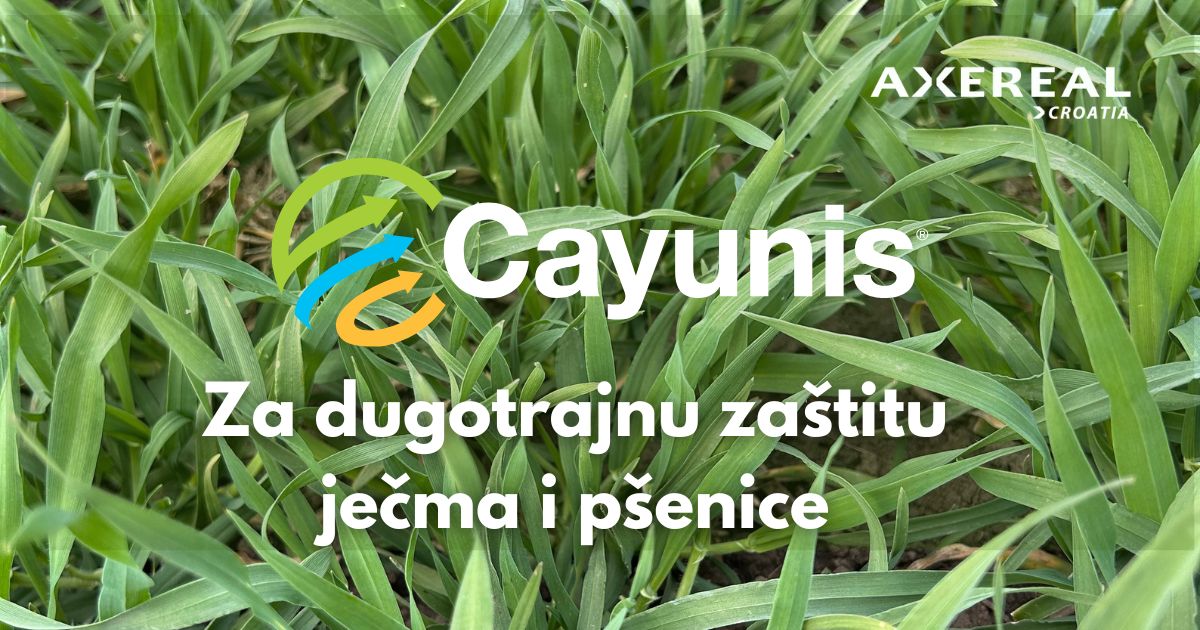
A reliable fungicide with high efficiency against a wide range of diseases in cereals.
Excellently protects barley from net leaf spot.
A powerful fungicide containing a combination of 3 active substances from the SDHI group and strobilurin that provides long-term protection of plant organs and crops.
An excellent tool in the fight against resistance.
It has a particularly favorable effect on the physiological processes in the plant and ensures better crop resistance to stressful conditions and higher chorophyll content, which ultimately brings higher yields.
Superior formulation that enables strong adhesion to the leaf surface and quick absorption, thus ensuring the success of the treatment even in the most difficult weather conditions.
Champs à renseigner
Image standard
Champs à renseigner
Texte
Composition
spiroxamine 150 g/L
trifloxystrobin 100 g/L
bixafen 75 g/L
Formulation
EC - liquid concentrate for emulsion
Recommended dose: 0,8 - 1 L/ha
Recommendations for application:
Champs à renseigner
Texte
In winter and spring barley for disease control:
Powdery mildew (Blumeria graminis), net spotted (Pyrenophora teres), gray spotted (Rhynchosporium secalis), ramularia (Ramularia collo-cygni), brown rust (Puccinia hordei) in the amount of 0.8–1 L/ha. The product is applied in the period when the conditions are favorable for the development of the disease, from the beginning of leafing to the beginning of flowering (BBCH 30-61), with a water consumption of 200-400 L/ha. A maximum of 2 applications are allowed with a minimum interval of 21 days between applications.
In winter and spring wheat for disease control:
Powdery mildew (Blumeria graminis), brown leaf spot (Mycosphaerella graminicola), brown rust (Puccinia recondita), yellow rust (Puccinia striiformis), yellow-brown leaf spot (Pyrenophora tritici-repentis), brown mold spot (Parastagonospora nodorum) in the amount of 0.8–1 L/ha. The product is applied in the period when the conditions are favorable for the development of the disease, from the beginning of leafing until the end of flowering (BBCH 30-69), with a water consumption of 200-400 L/ha. A maximum of 2 applications are allowed with a minimum interval of 21 days between applications.
In winter and spring rye for disease control:
Powdery mildew (Blumeria graminis), gray spot (Rhynchosporium secalis), brown rust (Puccinia recondita f. sp. secalis) in the amount of 0.8-1 L/ha. The product is applied in the period when the conditions are favorable for the development of the disease, from the beginning of leafing until the end of flowering (BBCH 30-69), with a water consumption of 200-400 L/ha. A maximum of 2 applications are allowed with a minimum interval of 21 days between applications.
In winter and spring, psenorrhage for disease control:
Powdery mildew (Blumeria graminis), brown leaf spot (Mycosphaerella graminicola), brown rust (Puccinia recondita), yellow-brown leaf spot (Pyrenophora tritici-repentis) in the amount of 0.8-1 L/ha. The product is applied in the period when the conditions are favorable for the development of the disease, from the beginning of leafing until the end of flowering (BBCH 30-69), with a water consumption of 200-400 L/ha. A maximum of 2 applications are allowed with a minimum interval of 21 days between applications.
Data on the method/mechanism of action of the agent
Champs à renseigner
Texte
Cayunis is a systemic fungicide that contains a combination of three active substances with different mechanisms of action: bixafen, spiroxamine and trifloxystrobin.
Bixafen from the carboxamide group inhibits succinate dehydrogenase in complex II (SDHI) and thus affects the process of cellular respiration. It binds to the waxy part of the plant and moves locally in the plant. Bixafen has a preventive and curative effect and has a wide range of effects. The active substance spiroxamine belongs to the group of amines. It acts on the reductase and isomerase enzymes in the process of ergosterol biosynthesis. It has a wide range of effects, and it has a preventive and curative effect. Trifloxystrobin is an active substance from the group of strobilurins, which also have a wide range of effects. It inhibits the transfer of electrons in the process of cellular respiration and belongs to the group of external quinone inhibitors (QoI). It is transported locally and systemically in the plant, and by its action it prevents the germination of fungal spores. Trifloxystrobin has a preventive and curative effect.
Texte
Phytotoxicity
If the agent is applied in the prescribed quantities and in the prescribed manner, it is not phytotoxic for the crops on which the application is approved. When applying the product, it is necessary to prevent the drift of the spray onto neighboring crops.
Texte
Resistance prevention strategy
Cayunis is a fungicide that contains three active substances that belong to different chemical groups and have different mechanisms of action, so the risk of developing resistance when applying the agent is reduced. Despite this, it is necessary to stick to the restrictions regarding the maximum number of applications and always use the prescribed amount of the agent.
Texte
Registered applications
Barley, wheat, rye, spelt
Waiting period
Guaranteed by the time of application on barley, wheat, rye and ryegrass
SAFETY DATA SHEET (SDS)
Champs à renseigner


